Climate Migration or Climate Immobility? Evidence from Micro-Level Causal Analysis of Migration Intentions in Nigeria

Abstract
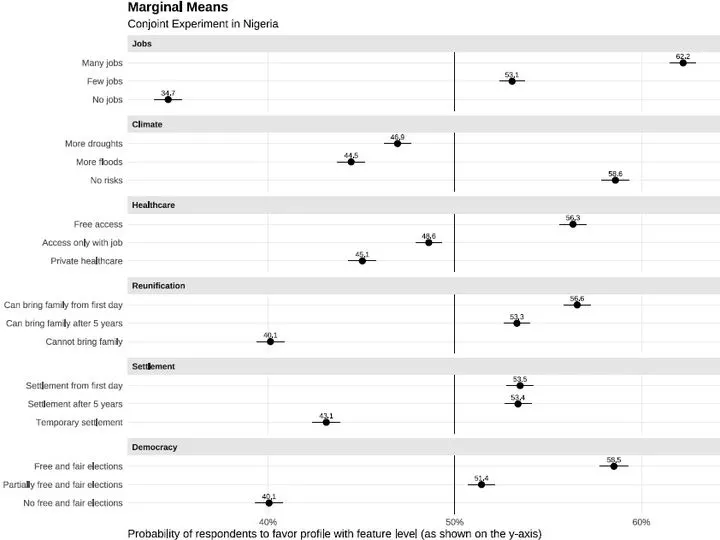
Climate change is a contested driver of international migration. We contribute to this debate by adopting a causal-inference perspective on micro-level migration preferences, in a literature that is dominated by aggregate or observational analyses prone to ecological fallacies, measurement error, and endogeneity biases. We examine multiple levels of exposure and types of climate hazards across both origin and potential destination locations typically studied in isolation. Using priming and choice-based conjoint experiments in Nigeria (N=3,450), we find that climate risks systematically reduce internal or international migration aspirations, a result compatible with short-term adaptation or forced immobility. Only individuals with direct personal exposure to sudden events like floods are more likely to migrate, and even then, migration does not emerge as a significant response. Climate also affects destination choices, but its influence is overshadowed by economic and political factors. Overall, climate risks appear to suppress, rather than activate, the resources and motivations necessary for migration.
Type
Publication
Journal of Ethnic and Migration Studies